Supercooled Fluidity
In our ordinary experience, cooling any substance causes its molecules to slow, lock together, and solidify into a rigid crystal lattice. Helium-4 is the sole exception to this universal rule. Due to its exceptionally low atomic mass and weak interatomic van der Waals forces, quantum zero-point fluctuations keep Helium liquid even at absolute zero, unless placed under 25 atmospheres of pressure.
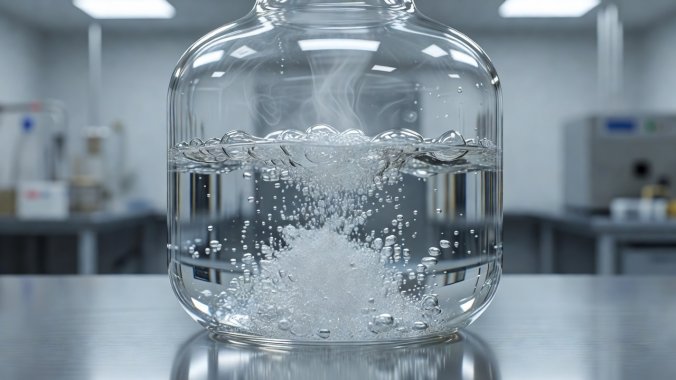
Crossing the Lambda Line: Helium-I to Helium-II
At atmospheric pressure, helium liquefies at 4.22 Kelvin. In this initial state (Helium-I), it boils vigorously like water in a kettle, turbulent with rising vapor bubbles.
When vacuum pumps draw down the pressure, evaporative cooling lowers the temperature. Precisely at 2.172 Kelvin (the Lambda Point, named after the Greek letter $\lambda$ due to the shape of its specific heat capacity curve), a dramatic transformation occurs: the boiling ceases entirely. The liquid becomes mirror-calm.
This occurs because Helium-II’s thermal conductivity surges to over 800 times that of high-purity copper. Any heat input is dissipated across the entire liquid volume instantaneously, eliminating localized thermal hot-spots where vapor bubbles could nucleate.
The Fountain Effect (Thermomechanical Flow)
Discovered in 1938 by John Allen and Harry Jones, the fountain effect illustrates how temperature gradients create mechanical pressure in a superfluid.
If a tube packed with fine emery powder is immersed in a bath of Helium-II and illuminated with a small light bulb, the superfluid component rushes into the heated powder to equalize the chemical potential. Because normal fluid cannot pass through the microscopic pores due to friction, the incoming superfluid builds intense hydraulic pressure, shooting a fountain of liquid helium up to 30 centimeters out of the top orifice.
The Rollin Film Phenomenon
Perhaps the most eerie property of Helium-II is its ability to defy gravity via the Rollin Film (named after Bernard Rollin).
Quantized Vortices & Two-Fluid Model
According to the two-fluid model developed by Laszlo Tisza and Lev Landau, Helium-II can be treated mathematically as an intimate mixture of two interpenetrating fluids:
- Normal Component: Carries all thermal entropy and possesses finite viscosity.
- Superfluid Component: Possesses zero entropy, zero viscosity, and zero curl ($\nabla \times v_s = 0$).
If you stir a bucket of superfluid helium, it cannot rotate like a rigid body. Instead, it breaks into a regular lattice of quantized vortex lines, each carrying an identical unit of quantum circulation:
κ = h / m ≈ 9.97 × 10⁻⁴ cm2 / s