Sonoluminescence Chambers
First recorded accidentally in 1934 by H. Frenzel and H. Schultes at the University of Cologne during underwater sonar experiments, sonoluminescence represents one of physics' most astounding energy-focusing transformations. By concentrating low-energy sound waves spread throughout a flask into a single microscopic point, mechanical energy is multiplied by a factor of over one trillion, generating visible and ultraviolet photons.
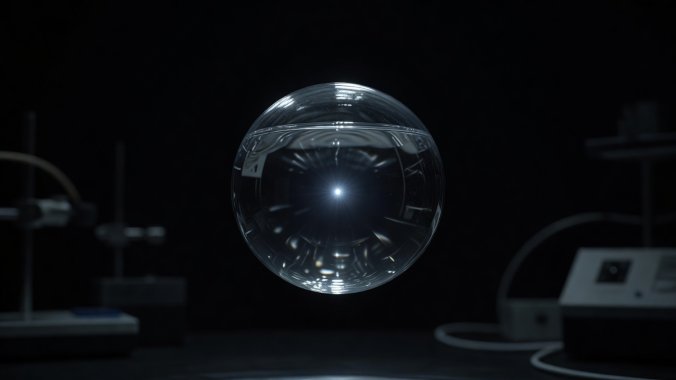
Single-Bubble Sonoluminescence (SBSL)
For over fifty years, sonoluminescence was observed only as an unpredictable, multi-bubble phenomenon in cavitation clouds. In 1989, Felipe Gaitan achieved a watershed breakthrough by creating Single-Bubble Sonoluminescence (SBSL): trapping one solitary bubble in a spherical standing acoustic wave, causing it to expand, collapse, and glow rhythmically with clockwork precision on every sound cycle.
The experimental geometry involves a spherical or cylindrical quartz flask filled with degassed deionized water, equipped with two piezo-electric ceramic transducers epoxied to opposite sides.
The Anatomy of an Acoustic Collapse
The life cycle of a sonoluminescing bubble unfolds across three distinct mechanical phases governed by the Rayleigh-Plesset equation:
- Slow Acoustic Expansion: During the rarefaction (low pressure) cycle of the acoustic wave, the bubble expands from an ambient radius of roughly 4.5 microns to an enormous 50 microns.
- Catastrophic Inertial Collapse: As the acoustic wave shifts to high pressure, the surrounding water rushes inward. Driven by atmospheric pressure and water momentum, the bubble walls collapse inward at supersonic velocities exceeding Mach 4.
- The Flash & Bounce: At minimum radius (under 0.5 microns), the interior gas cannot compress further. The enclosed gases heat via adiabatic compression to temperatures between 8,000 K and 15,000 K, generating a flash of light lasting fewer than 100 picoseconds, followed by smaller acoustic rebounds.
Spectroscopy & Plasma Core Hypotheses
Optical spectrometry reveals a continuous, featureless emission spectrum that grows steadily brighter into the ultraviolet, closely matching blackbody radiation or thermal bremsstrahlung radiation from an ionized plasma. This confirmed that the emission is not simply standard molecular luminescence, but thermal radiation originating from an ultra-dense, localized plasma core.
Laboratory Parameters for Stable SBSL
| Operational Variable | Standard Lab Range | Physical Impact on Emission |
|---|---|---|
| Acoustic Frequency | 20 kHz to 40 kHz | Determines resonance cavity geometry |
| Drive Pressure Amplitude | 1.2 to 1.5 bar | Must overcome Bjerknes stability limit |
| Water Temperature | 0 °C to 4 °C (Chilled) | Cold water reduces vapor pressure, maximizing flash |
| Dissolved Gas Fraction | 15% to 25% saturation | Prevents uncontrolled multi-bubble nucleation |