Quantum Levitation Discs
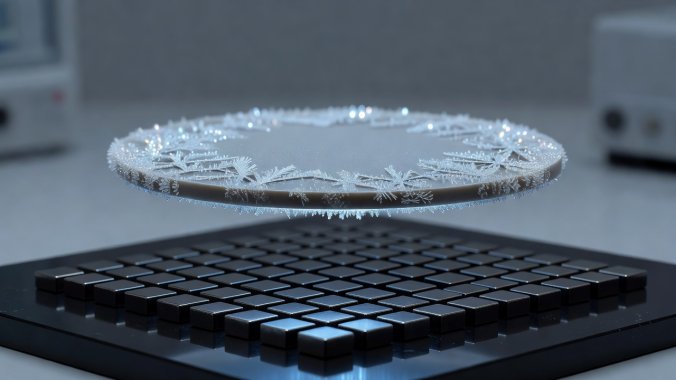
Few visual spectacles challenge our everyday comprehension of gravity as violently as a frosted ceramic pellet hovering motionless in empty air. While popular media frequently calls this "magnetic levitation," the true mechanical phenomenon is quantum flux pinning, an intricate quantum state governed by Type-II superconductors.
The Failure of Classical Magnetism: Earnshaw's Theorem
In classical electrodynamics, Samuel Earnshaw proved in 1842 that a collection of point charges or classical permanent magnets cannot be maintained in a stable stationary equilibrium configuration through electrostatic or magnetostatic forces alone. If you bring two permanent bar magnets together with matching poles, they may repel vertically, but they will inevitably slide sideways or flip upside down to align opposite poles.
To achieve unconditional stability without mechanical guides or electronic feedback loops, one must either employ diamagnetic materials (like pyrolytic graphite) or quantum superconductors.
The Meissner-Ochsenfeld Effect vs. Type-II Flux Pinning
When Walther Meissner and Robert Ochsenfeld investigated pure lead and tin in 1933, they discovered that upon dropping below their critical transition temperatures (Tc), these metals did not merely become zero-resistance conductors; they acted as perfect diamagnets. They developed surface screening currents that cancelled out any internal magnetic field entirely ($B = 0$). This is the standard Type-I Meissner effect.
However, pure Type-I materials can easily be overwhelmed by relatively weak external magnetic fields, which pierce the screening currents and destroy superconductivity.
In Type-II superconductors—such as Yttrium Barium Copper Oxide ($YBa_2Cu_3O_{7-\delta}$), discovered in 1987 by Paul Chu and Maw-Kuen Wu—the physics changes dramatically. Type-II superconductors tolerate strong magnetic fields by allowing the lines of flux to pierce the crystal in discrete, quantized bundles called Abrikosov vortices.
Three-Dimensional Spatial Memory
Because the magnetic field lines are physically pinned inside microscopic columnar defects, the disc does not merely resist falling toward the magnet; it resists any deviation from its original cooling position. If you cool the superconductor 15 millimeters above the magnet, it remembers that 15 mm gap.
- Inverted Suspension: If you turn the magnetic track upside down, the disc remains suspended underneath it, resisting the pull of gravitational acceleration.
- Lateral Stability: If you nudge the disc sideways over a uniform magnetic track, it glides frictionless along the axis of magnetic symmetry, but resists any off-axis displacement.
- Rotational Independence: A disc placed over a circular multipole ring can spin perpetually at thousands of revolutions per minute, dampened solely by atmospheric air resistance.
Tabletop Laboratory Verification
To reproduce this phenomenon in an educational physics laboratory, the procedure requires:
- A sintered disc of $YBa_2Cu_3O_{7-\delta}$ (approx. 25 mm diameter by 5 mm thick).
- Liquid Nitrogen ($LN_2$) at 77.36 Kelvin, handled with insulated cryo-gloves and face shields.
- A high-grade Neodymium Iron Boron ($NdFeB$) circular track (N45 or N52 rating).
- Plastic or non-magnetic tweezers to place and position the chilled disc.