Non-Newtonian Impact Shields
Sir Isaac Newton defined fluid dynamics in 1687 with a foundational axiom: a fluid's viscosity (its resistance to deformation) depends solely on its chemical composition and temperature, remaining unaffected by the rate of shear or physical force applied. While this law accurately predicts water, alcohol, and motor oils, complex multiphase suspensions flagrantly breach it.
The Physics of Hydrodynamic Lubrication Breakdown
Consider common "oobleck"—a colloidal suspension of roughly two parts cornstarch to one part water by volume. In a resting state, individual starch polysaccharide granules (averaging 10 to 15 microns in diameter) are completely surrounded and separated by a microscopic lubricating film of water molecules.
When you slowly insert a finger into the bowl, the low shear strain rate gives the water molecules ample time to flow around the granules. The granules slide past one another effortlessly, and the substance pours like liquid cream.
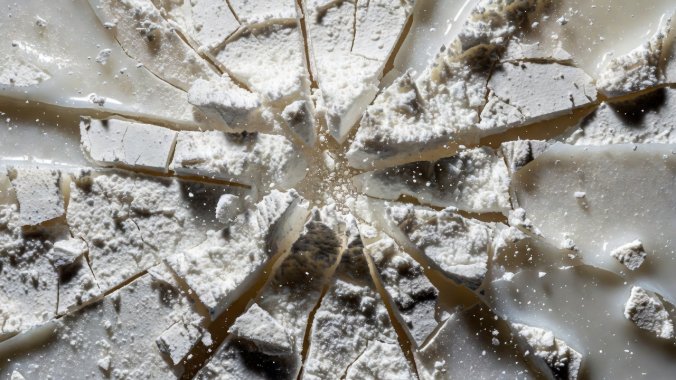
However, when the mixture experiences an abrupt impulse—such as a fist strike, the impact of a steel bearing, or the footfall of a runner—the displacement rate vastly exceeds the speed at which water can navigate the microscopic interstitial pores. The lubricating layer collapses, forcing the irregular granule surfaces into direct frictional contact. This creates self-assembling jamming clusters that transmit stress throughout the entire fluid column in milliseconds.
Continuous vs. Discontinuous Shear Thickening (DST)
Continuous Thickening
Viscosity increases smoothly with shear rate. Observed in moderate-concentration silica suspensions and diluted polymer solutions. Useful for steady viscous dampening.
Discontinuous Thickening (DST)
At a critical stress threshold ($\tau_c$), the effective viscosity experiences a near-vertical jump of 3 to 4 orders of magnitude, behaving essentially as a rigid crystalline solid.
Ballistic Applications: Liquid Armor
Contemporary military and defense researchers, including teams at the U.S. Army Research Laboratory and the University of Delaware, have developed advanced flexible armor systems utilizing STFs (Shear Thickening Fluids).
Traditional bullet-resistant vests composed of pure Kevlar or Ultra-High-Molecular-Weight Polyethylene (UHMWPE) require 20 to 40 rigid layers to disperse projectile kinetic energy, restricting an operator's mobility, neck rotation, and joint articulation. By impregnating fewer Kevlar layers with a colloidal suspension of silica nanoparticles dispersed in polyethylene glycol (PEG), engineers created fabrics that remain pliable during normal walking and running motions.
Upon high-velocity impact from shrapnel or a ballistic round, the embedded suspension instantly locks into a rigid composite sheet, distributing the kinetic energy over a broad surface area and preventing projectile penetration.
Laboratory Test Matrix
| Test Parameter | Low Shear State (< 10 s⁻¹) | Critical Stress State (> 150 s⁻¹) |
|---|---|---|
| Dynamic Viscosity | ~1.2 Pa·s (similar to maple syrup) | > 2,500 Pa·s (approaching solid chalk) |
| Inter-particle Distance | Hydrated separation (> 50 nm) | Direct frictional contact (< 2 nm) |
| Surface Response | Capillary meniscus wetting | Brittle shear fracture lines |
| Energy Dissipation | Viscous laminar dissipation | Elastic lattice strain wave propagation |